
 381 60 30 65 800



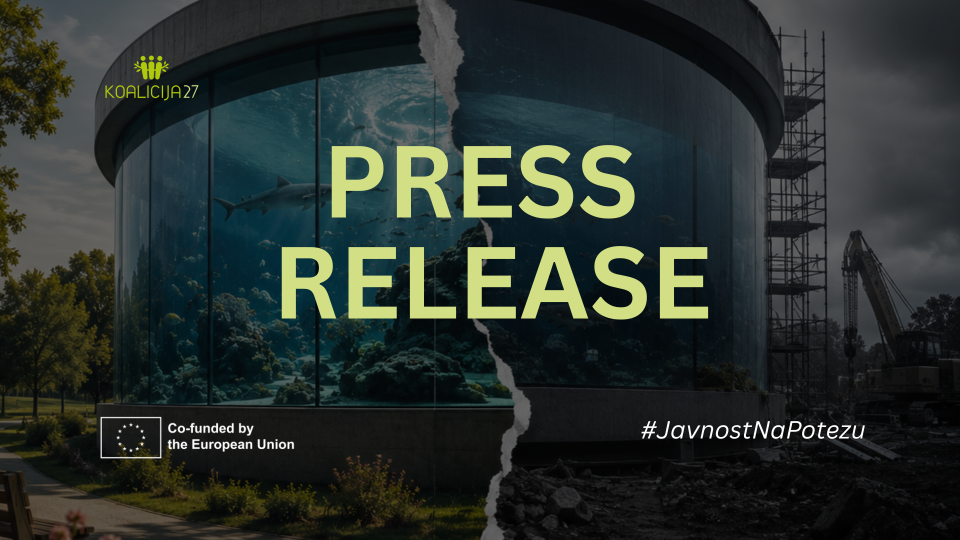
The Secretariat for Environmental Protection of the Belgrade City is expected to decide within the next few days (by 15 June) whether the planned construction of the “Belgrade Aquarium” in Friendship Park should be subject to an Environmental Impact Assessment. If the City determines that an Environmental Impact Study is not required, one of the few large green areas in the wider city centre of Belgrade could be permanently altered without a comprehensive assessment of the environmental consequences.
It should be recalled that the public consultation period regarding the Request for a Decision on the Need for an Environmental Impact Assessment for this project ended on 5 June. The City of Belgrade now has a legal deadline of ten days to issue its decision. The project developer and applicant is the Ministry of Finance.
The City of Belgrade on the test: How much are nature protection and climate resilience worth?
Coalition 27 warns that the planned construction of the aquarium in Friendship Park is not merely a question of a single building. Rather, it is a question of whether Belgrade will preserve its most valuable public green spaces or continue transforming them, step by step, into construction sites. The area in question is simultaneously a public park, a protected cultural heritage site, and a core element of Belgrade’s green infrastructure network. It is located adjacent to the ecological network boundary and the highly sensitive confluence of the Sava and Danube rivers, including the Great War Island.
An analysis of the documentation submitted by the Ministry of Finance indicates that not all potential environmental impacts of the project have been adequately assessed, nor have the cumulative effects of the planned developments in Friendship Park and the Ušće area been properly considered.
The aquarium is not an isolated project but part of a broader development framework involving additional buildings and supporting infrastructure. Therefore, assessing the aquarium solely as an individual structure is insufficient without considering its overall impacts on the city’s green infrastructure, microclimate, water regime, biodiversity, cultural heritage, and residents’ quality of life, particularly in light of the increasingly climate change impacts affecting Belgrade.
Belgrade’s General Urban Plan recognizes green spaces as a public good and an essential component of the city’s climate and ecological infrastructure. For this reason, the screening procedure regarding the need for an Environmental Impact Assessment must not be treated as a mere formality, but rather as an opportunity to determine whether construction is appropriate in an area that already possesses exceptional public, ecological, and cultural value.
Particularly concerning is the fact that the proposed development is being presented as an improvement of the area, despite the project involving the occupation of a significant portion of the park and the transplantation of a large number of trees. Transplanting mature trees does not guarantee their preservation; on the contrary, it carries substantial risks to their vitality and long-term survival. When cities lose mature trees, they lose much more than greenery. They lose shade, protection from extreme temperatures, natural stormwater retention capacity, habitats for plant and animal species, and one of the most important mechanisms for climate change adaptation.
Coalition 27 calls on the Secretariat to ensure that its decision-making process is guided by the public interest, national legislation, and international environmental protection standards.
Friendship Park is not an empty space awaiting a new purpose. It is one of the few large green areas in central Belgrade, an integral part of the city’s identity, and a key element of its resilience to climate change. At a time when Belgrade is already experiencing increasingly frequent heatwaves, droughts, and extreme weather events, preserving existing green spaces is a matter of public interest and an essential component of citizens’ quality of life.