
 381 60 30 65 800



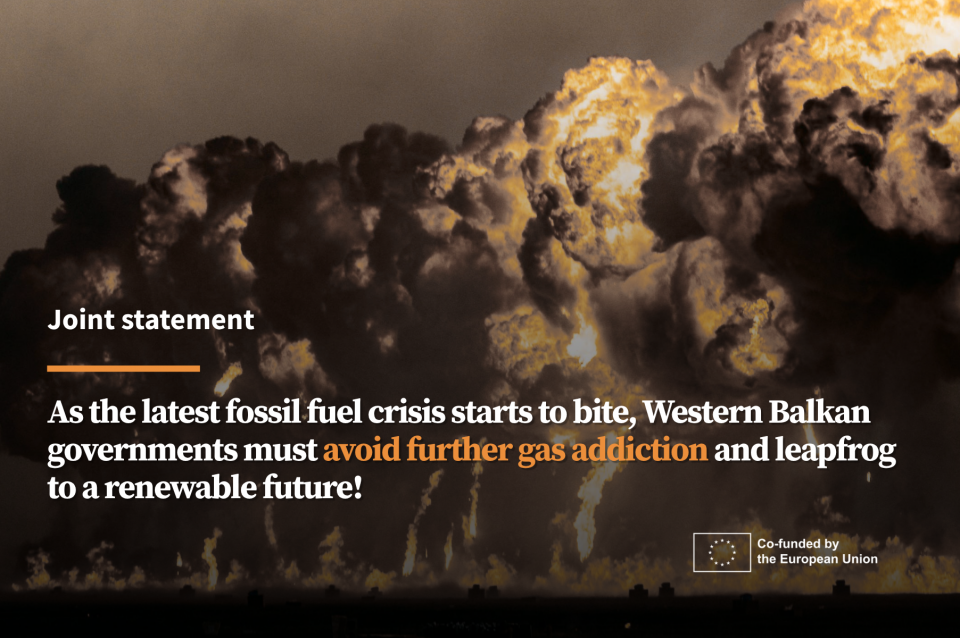
47 civil society organisations have today called on Western Balkan governments to resist pressure from the United States and cancel plans to build new gas pipelines and power plants. In a joint statement, the groups warn that far from merely replacing Russian gas, the plans would massively increase the region’s gas consumption and its dependence on imported fossil fuels.
For several years, the United States has been pushing projects like the Greece to North Macedonia interconnector, liquid gas (LNG) terminals in Montenegro and Albania, and the southern gas interconnection between Croatia and Bosnia and Herzegovina.
At this week’s Three Seas Initiative Summit in Dubrovnik, an inter-governmental agreement is planned on the latter, while a planned US-Montenegro agreement has already met with strong resistance from civil society and people living near the planned LNG terminal in Bar.
Ognjan Pantić, Belgrade Open School: “Plans for further development of gas infrastructure in our region are not accompanied by analyses of investment justification that would take into account both the current situation, marked by limited gas availability and unpredictable prices, and future trends. If we consider the time required to develop new gas infrastructure, as well as policies and financial instruments that are increasingly making the use of fossil fuels more difficult, our region has the opportunity to avoid the trap of heavy gas dependence that the EU once fell into. This can be achieved by focusing on the further development of renewable energy capacities (solar and wind), complemented by hydropower, as well as by relying on modern technologies in heating (and cooling) and further improving energy efficiency (reducing energy consumption and losses).”
Compared to the EU, the Western Balkan economies have low or no gas dependence. Despite a reduction in consumption, in 2024, gas comprised over 20% of available energy in the EU. But in the Western Balkans, the most gas-dependent economies were Serbia (14%) and North Macedonia (12%). In Bosnia and Herzegovina gas makes up less than 3% of energy, with Albania, Montenegro and Kosovo* not connected to international gas infrastructure.
But instead of seeing this as an advantage to capitalise on, most Western Balkan governments are actively planning gas pipelines, power plants and LNG terminals that could collectively triple their 2023 gas consumption. These would, according to the joint statement, either entrap the WB economies in costly import dependence, or end up as stranded assets.
Serbia’s difficulty in securing its gas supply has not put its government off steadily expanding the country’s gas network. In February the government signed an agreement with Azerbaijan for a 500 megawatt gas power plant in Niš. It also plans a new plant in Novi Sad.
Pippa Gallop, CEE Bankwatch Network: “In the midst of yet another fossil fuel crisis, it’s unbelievable that governments are still planning new gas pipelines and power plants. They would cost billions, even before the costs of gas are included, and would likely end up as stranded assets, or be heavily subsidised by taxpayers. Planning and construction could easily take a decade in most cases – too late to replace Russian gas – and the region does not have money or time to waste on such expensive mistakes.”
The groups are calling on the region’s governments to focus on appropriately-sited solar and wind generation – supported by existing hydropower and strong grid connections – for electricity generation, and heat pumps, geothermal, and ambient or leftover heat for heating and cooling. They also call for more action on energy efficiency and electrification of the heat and transport sectors.
Contacts:
Belgrade Open Scholl
Pippa Gallop, CEE Bankwatch Network
Gligor Radečić, CEE Bankwatch Network
This analysis was conducted as part of the project “Green Agenda Navigator”, co-financed by the European Union. The project is implemented by the Belgrade Open School in cooperation with six regional partners: Aarhus Center Association, Eko-Tim, Eco-Z, the Center for Environmental Research and Information Eko-svest, an organization for nature protection and conservation in Albania, and the CEE Bankwatch Network.
*This designation does not prejudice the status of Kosovo and is in accordance with United Nations Security Council Resolution 1244, as well as the International Court of Justice's opinion on the Kosovo declaration of independence.